
Defining Distance Learning
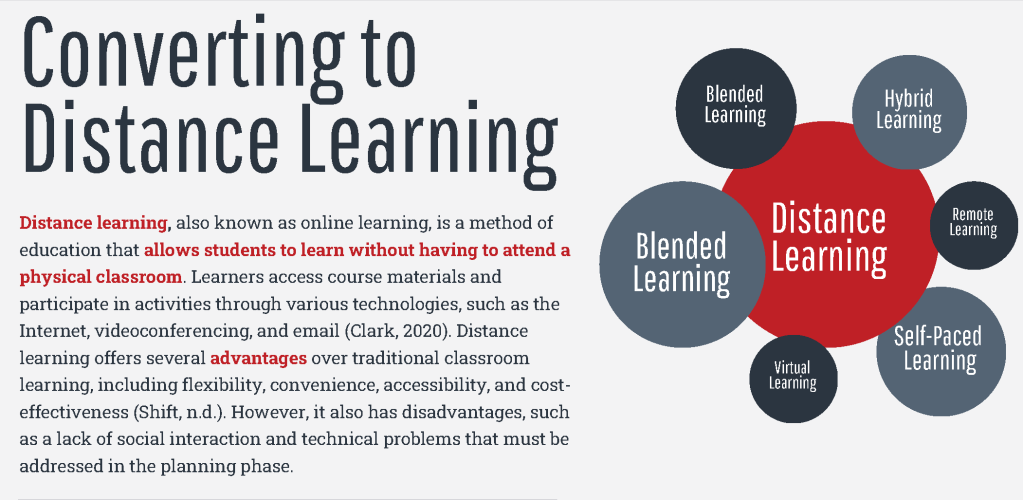
Before this course, I was exposed to multiple modalities in which instructional content is designed, delivered, and evaluated. Distance learning in corporate America requires content to be provided simultaneously across entire enterprises. For example, a national company is releasing a new product in a few days and needs to ensure its workforce is fully up to speed. The business can incorporate e-learning, virtual instruction, leadership training, or advanced technology to deliver education. I have been exposed to more advanced strategies that can sometimes be considered experimental in past technologies. One training session I attended was an immersive experience where leaders were placed in the same mock store. The competencies/action was delivered by a trainer located outside the room. In this modern facilitation, even though the learners and instructors are located in the same place geographically, the separation of facilitators allows the categorization of distance learning. The learners received printed instructions to complete a task included in the end-of-day store recovery efforts. The learners review education and complete the actions needed for adequate cognitive processing through social interaction with peers. In other methods of Teaching, I have experienced additional, more common distance learning practices using further learning or content management software. Despite the modality of instruction, all delivery methods require the separation of facilitators and learners to engage and interact to process, store, and recall information.
When we reflect on distance learning, it becomes crucial to consider both distance education and distance teaching. For instance, we need to consider whether learners can access the instructional content and how the instruction is delivered. Additionally, we must explore how the chosen delivery method facilitates social interaction. These are all critical factors that contribute to the foundation of distance learning. With the invention of the World Wide Web and micro-computing, instructional content continuously revolutionizes the learning experience (Walden University, n.d.). Overall, distance learning is characterized by four main features: Instructional content delivered by an institution, physical separation between learners and facilitators, use of technology to bridge this gap, and the establishment of learning communities (Simonson et al., 2019, p.31). With these characteristics, individuals seek to acquire knowledge or enhance their skills by using the technology implemented by the institution creating a unique group experience.
Purposed new definitions, also known as open learning, incorporate advancing technology to bridge the gap between mass-produced instruction to an abundance of learners while focusing on the specific needs of both remote and local markets. (Moller et al., 2008, p.66). I believe the definition still does not include an important role in distance learning; learner actions. The addition brings light to the actions or input required by learners to interact in a digital format. Many instructional innovations, such as virtual/augmented reality and gamification, need learners to engage and interact with the content to learn.
In the first example, delivered with recent emerging technologies, virtual training was implemented to solidify the importance of following store opening and closing guidelines to retail managers. Although physically located in the same room, retail managers were immersed in a real-world situation stimulating visual and auditory sensors and only equipped with a controller. As the scenario unfolded, managers found themselves in the middle of a store buglers. The managers could move around the store, hide, and interact with situational questions while processing colorful language screamed at them. The digital experience generated critical thinking, quick reactions, and even a heightened emotional response by the manager. Managers were required to perform some actions to interpret content delivered virtually. In this example, the learner was triggered by an emotional response, which led to interacting in the scenario. This response action is crucial to interpreting virtual or distance instruction.
In another example, more educational-driven coursework is delivered through a learning management system. Learners must interact with each topic to ensure quality learning. The learner’s dedication and drive are internally motivated, influencing the learner’s interaction with digital content. Without motivation, all the learning material will not be reviewed to ensure quality learning.
In conclusion, a new definition of distance learning could be defined as learning that socially connects instructors and peers, separated geographically through the learner’s interaction with engaging technologies to establish a desired knowledge level.
Resources
Abraham Bijeesh, N. (n.d.). Advantages and disadvantages of distance learning. India Education. https://www.indiaeducation.net/online-education/articles/advantages-and-disadvantages-of-distance-learning.html
Burns, M. (2011). Distance Education for Teacher Training: Modes, Models, and Methods. Education Development Center, INC. https://www.edc.org/sites/default/files/uploads/Distance-Education-Teacher-Training.pdf
Cao, Yu, “Adult distance learners in distance education : a literature review” (2002). Graduate Research Papers. 462. https://scholarworks.uni.edu/grp/462
E. (2022, September 21). The role of technology in distant learning. Ecole Globale. https://www.ecoleglobale.com/blog/the-role-of-technology-in-distant-learning/
ezTalks. (n.d.). 7 best cloud collaboration tools. ezTalks. https://eztalks.com/video-conference/7-best-cloud-collaboration-tools.html
Moller, L., Foshay, W., & Huett, J. (2008). The evolution of distance education: Implications for instructional design on the potential of the web (Part 2: Higher education). TechTrends, 52(4), 66–70.
Moller, L., Forshay, W. R., & Huett, J. (2008). The Evolution of Distance Education:Implications for Instructional Design on the Potential of the Web. TechTrends, 52(3), 70-75.
Role of Digital Technology in Distant Learning in Present Era (n.d.). Role of Digital Technology in Distant Learning in Present Era. https://www.linkedin.com/pulse/role-digital-technology-distant-learning-present-era-priyankar
Saba, F. (2016). Theories of distance education: Why they matter. New Directions for Higher Education, 2016(173), 21–30. https://doi.org/10.1002/he.20176
Selecting Education-Driven Technologies for Distance Learning. (n.d.). Selecting Education-Driven Technologies for Distance Learning. https://ies.ed.gov/ncee/edlabs/regions/pacific/blogs/blog40_selecting-education-driven-technologies-for-distance-learning.asp
Simon, J. (2021, March 5). Distance learning: The complete guide (2020). TechSmith. https://www.techsmith.com/blog/distance-learning/#distance-learning
Simonson, M., Berg, & Gary, A. (2007, November 7). Distance learning. Encyclopedia Britannica. https://www.britannica.com/topic/distance-learning
Simonson, M. R., Smaldino, S. E., & Zvacek, S. (2019). Teaching and learning at a distance: Foundations of distance education (7th ed.). Information Age Publishing.
Stauffer, B. (202, April 2). What’s the difference between online learning and distance learning? Applied Educational Systems. https://www.aeseducation.com/blog/online-learning-vs-distance-learning
Theory of Distance Education (2001) The Handbook of Research for Educational Communication and Technology. Available at: http://members.aect.org/edtech/ed1/13/13-03.html (Accessed: 04 July 2023).
Walden University, LLC. (Producer). (n.d.). Distance education: The next generation [Video file]. Retrieved from https://class.waldenu.edu




 ID Insights
Leave a reply to sandimma Cancel reply